Everyday has been full since our last post, as we are heading to the far east of Morocco to make our way overland by whatever means to the dunes of the Sahara for Christmas. We left Chefchaouen though (this time by the correct route), along the route north to the Mediterranean coast following the track of the Oued Ifertan, which was as far from desert-like as you can imagine. Fertile farming land with lots of small landowners working their lands by whatever means they have, including a pair of donkeys with wooden makeshift plough. Their produce was then sold roadside on stalls, with food miles measured in metres, selling mint for tea, carrots, radishes etc.

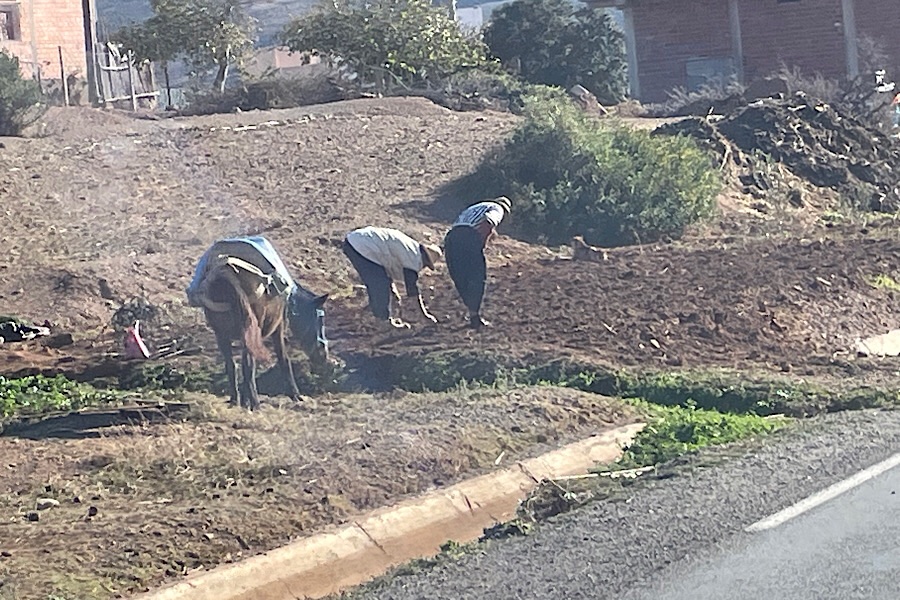
The dress of the local ladies in particular looked almost more South American than Muslim / African, with wide brimmed straw hats, sometimes with colourful pompoms around the rim and flowing dresses and shawls. Perhaps it is due to the historic Spanish influence, as the northern coast of Morocco was carved up in agreements with France to be a protectorate of Spain in 1906, following a dispute over the Spanish enclave in Ceuta. Tens of thousands of colonists arrived to exploit the resources within Morocco and bloody disputes followed.
An uprising in the Rif Mountains, near Chefchaouen was eventually put down in 1927 by the Franco-Spanish military using bombing raids and Mustard gas. Moroccans served for France in World War I and II and for the Spanish National Army in the Spanish Civil War. It was not until March 1956 that Morocco gained its independence from France and a month later that Spain gave up its northern protectorate, but to this day maintains enclaves in Melilla and Ceuta plus a number of small islands off the coast.

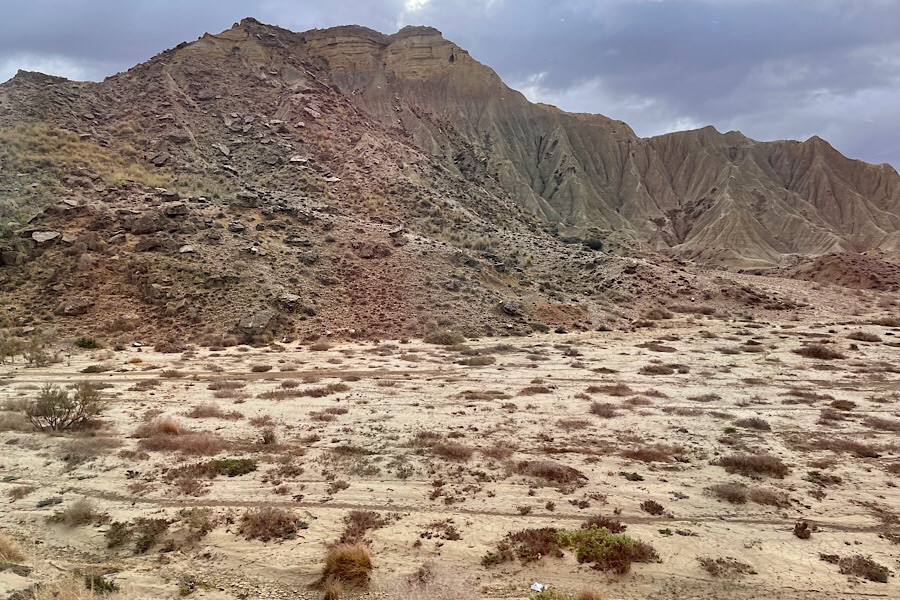

When we hit the Mediterranean we turned right on the N16 to head east along the length of the coastline. The first day was mountainous, climbing up cliffs and down into valleys, with stunning views all along the way. However, going was very steady through the multiple switchbacks and in the 170+km travelled that day, I don’t think we once managed to hit top gear, even Google maps calculated the travel time at 43km/hr as an average. Huge landslides and subsidence had caused undulations in the road surface like reverse speed bumps, which meant even on a straighter sections of road you could never relax your guard.
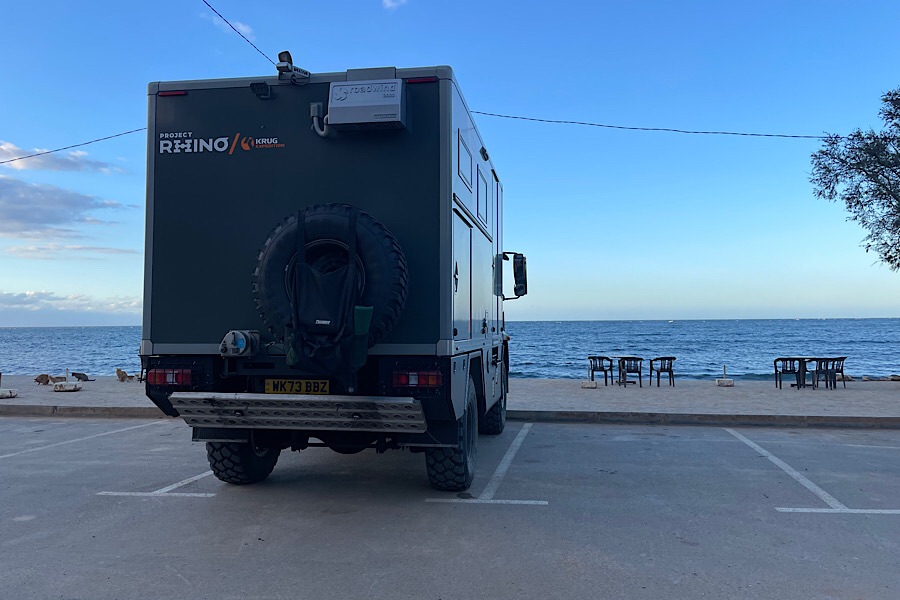
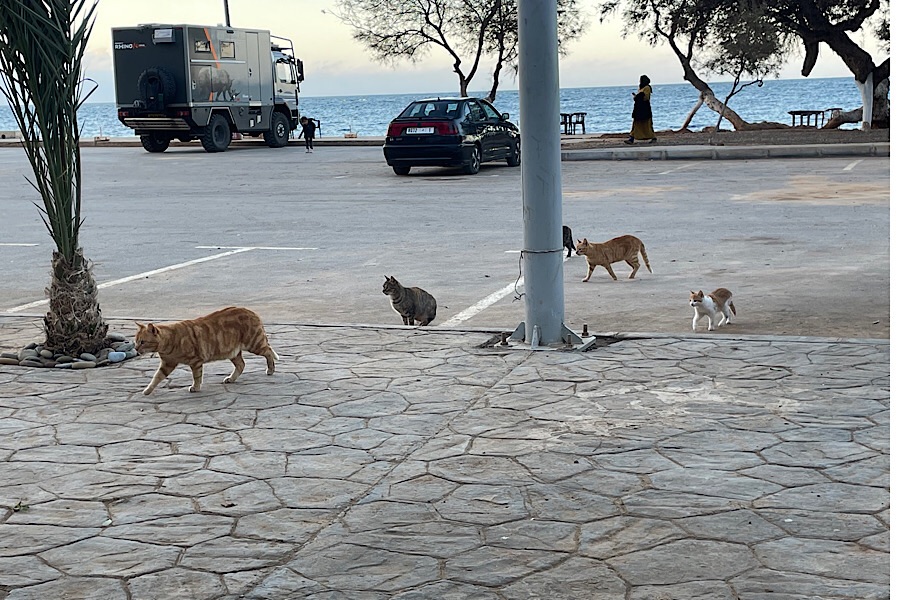
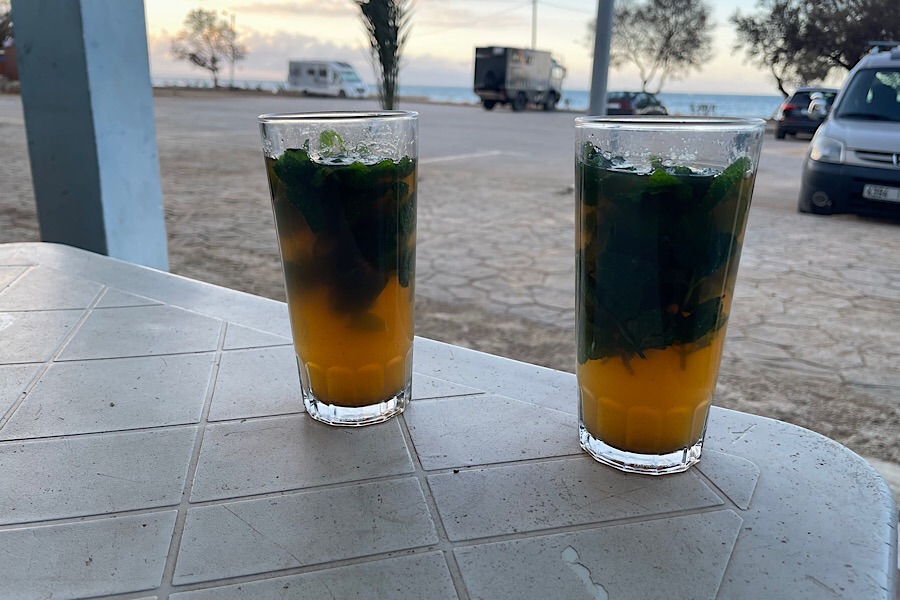
We had a lovely seafront park up for the night with the sound of waves as backdrop for the evening. As we pulled up there was a motorhome literally just turning off their engine ahead of us who turned out to be a UK couple from Barnoldswick, UK, not far from where we used to live in the North West. We decided to visit the beachside café for the obligatory mint tea and was amused to see a Man Utd v Liverpool game with Arabic commentary on the TV inside. The usual collection of stray cats and dogs made our evening dog walk with our dog and cat reactive Border Terriers the usual high excitement. Thankfully the stray dogs sensibly gave the crazy howling terrier dogs a wide berth and the cats gave them a cool stare with their usual admirable nonchalance.

We managed a morning dog walk upto the Spanish fort at the top of the hill in Torres-de-Alcala the following morning but found it closed and had to return back, a guardsman at the neighbouring military building watching us all the way.

The next day, our coastal trip was less mountainous but not a great deal faster going. The five different map versions we have for Morocco are fairly evenly split on whether the north coast road is a major or a minor road and I think that fairly reflects its actual status of as a work in progress. Some pristine sections of single track tarmac either side of the very dilapidated original road and a fair drop between them with a free-for-all on which bit to drive on.
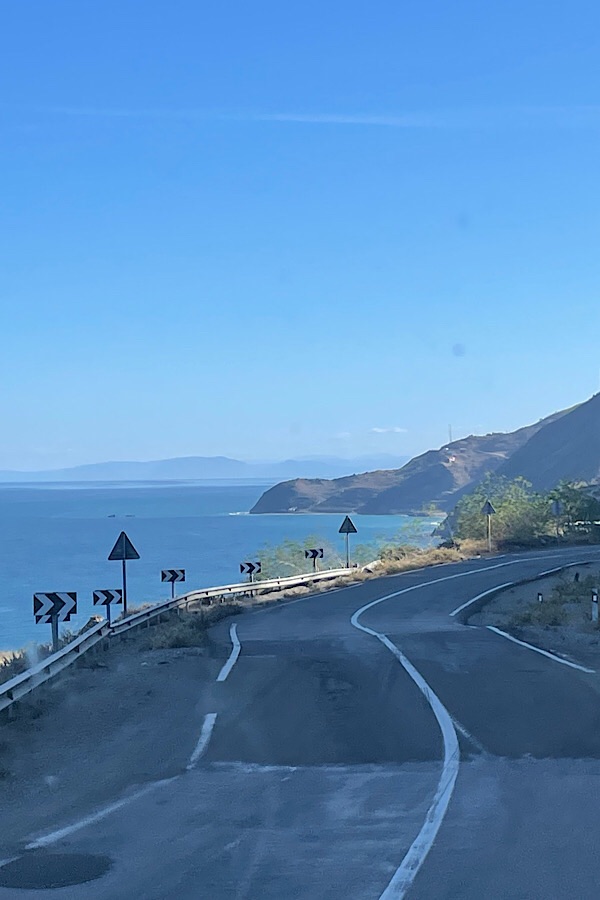
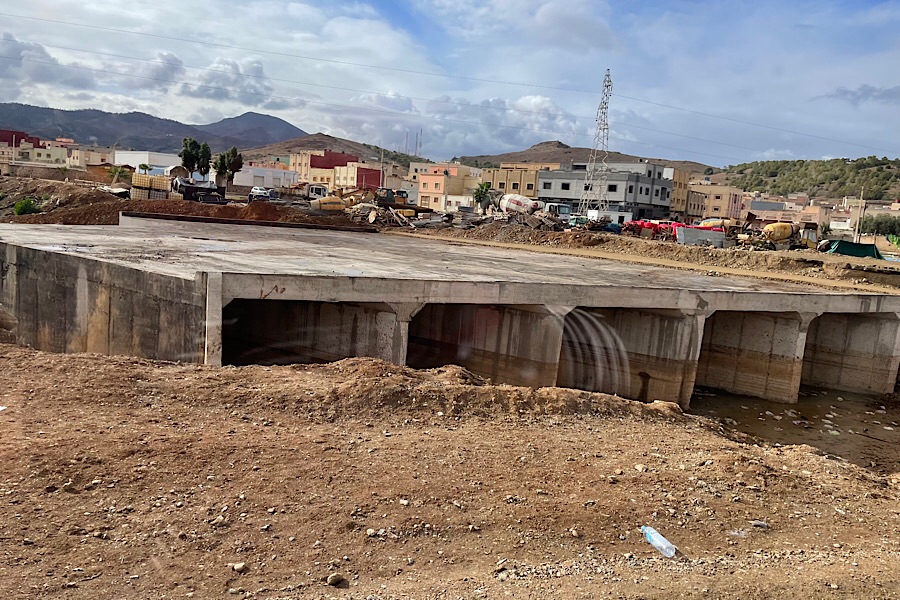

Then sections of new road but as soon as the road was due to pass over one of the regular oued / rivers running into the sea, those sections were still being built and four lanes of traffic converged to two lanes of rough gravel by-pass. Add to this the usual mix of pedestrians, cyclists and mopeds (usually going against the traffic), donkey carts and people manoeuvring wheel barrows and goodness knows what else and it makes for an eventful journey. On this road trip, we are truly learning that the journey is the destination.
We have, most unusually for us, at this point of our trip been in Morocco for nearly a week without trying the local cuisine and Kevin is desperate to try a tagine. Around lunchtime each day we have looked longingly for a roadside restaurant but found none, pulling over eventually for a sandwich etc, only of course to pass the perfect clifftop panoramic restaurant a few minutes after we have eaten. Anyway, when we had a choice for our overnight stop that night of another isolated carpark or the Riad Ocean View with camping and homemade cuisine, which had been visited and recommended by two separate people we follow online, it was an easy choice for the evening.

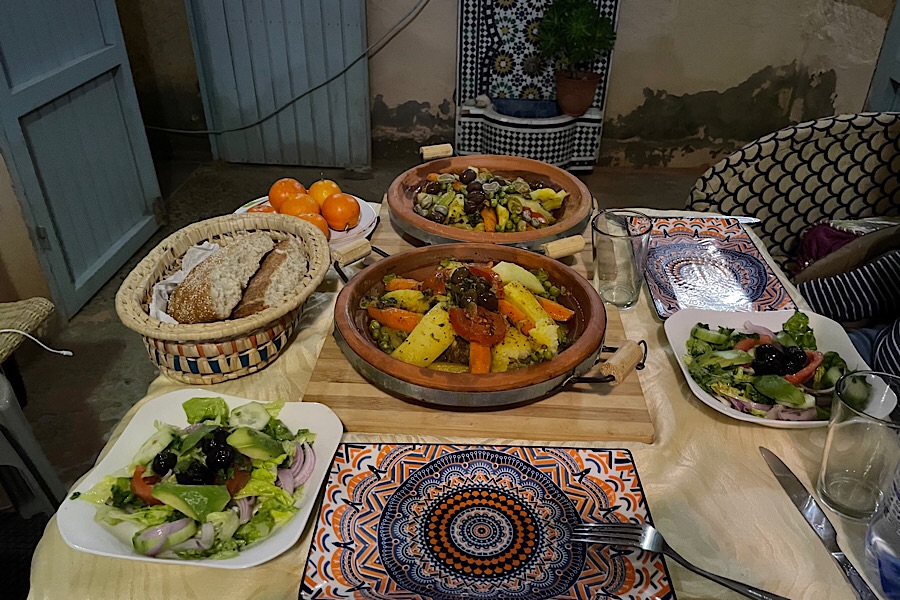
We were given a warm welcome by Abdel, who interrupted his busy work their organic farm when we arrived, later returning to his weeding and watering until after dark. However, his wife prepared us two delicious taglines, a veggie one for me and a lamb one for Kev, served with fresh salad, bread and tangerines. We were served in dining room built into the outer wall of their riad, preserving the inner sanctum for the family, (Muslim women traditionally only remove their headscarves within the inner sanctum) which apparently also houses peacocks in their walled garden.

The following morning our first job was a final shop before we head into the desert for Christmas. We chose the Carrefour Market in Berkane, being one of our favourite brands in France and as a European supermarket also potentially stocking alcohol. The drive through Berkane after the fairly quiet coastal roads with small towns and by-passes was a culture shock, people and vehicles in all directions, one near miss and requiring 100% concentration and this was only a small town. So imagine how disappointed we were when we found that there did not seem to be the discrete door at the back of the store we had been told to expect, to let us into the naughty alcohol room.

Thankfully, with Kevin’s prompting I asked the friendly young male guy at the till in French if they sold beer and he responded like ‘of course we do”, go out the store, then right and right again. We followed his directions and found what looked like a loading bay with clear thick plastic flaps across the door hiding a room full of alcohol and several locals partaking of the supplies. They had all the international brands and a few local ones too, though at European prices or higher. We picked up some extra supplies, as we had not gone over the top when we left Spain and are planning the join a meet up on Boxing Day, so do not want to run short. Also, we decided we really ought to have French 75 cocktails from the film Casablanca on Christmas Day, so we needed some extra ingredients.
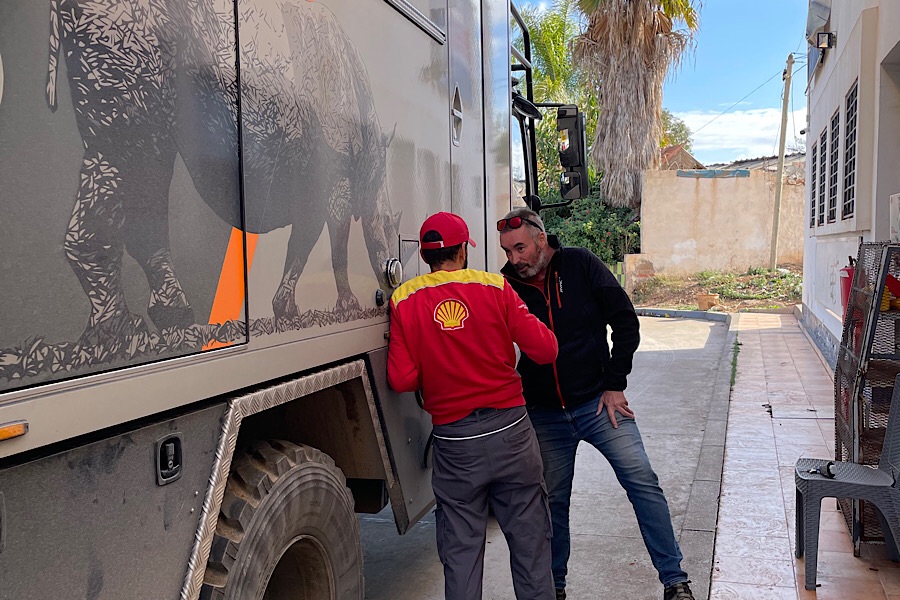
We breathed a sigh of relief that we did not have to venture into the centre of the much bigger city of Oujda for supplies and instead set off to head south to the desert! One final stop first though to top off our fuel and whilst we were there, washer bottle and AdBlue just to make sure we were fully stocked. We chose a Shell Station, though all the fuel stations are a similar price (we paid £1.06 / litre), I understand it is fixed by the government in some way. Our attendant (it is not self-service here) was so lovely, attentive and friendly, so characteristic of what we had been led to expect of the locals and 100% of our experience of those we have met so far. I asked about AdBlue and windscreen wash and he insisted on filling them himself. We had the obligatory football fandom conversation, he was a Man City fan, which we being rugby fans we struggle to participate with, but joined in as best we could. He ended by showing us a video on his phone of his son speaking English which he was obviously so proud of, it was a really heartwarming exchange.
To reach the Sahara we had to cross the Atlas Mountains, though for this crossing at least, not the High Atlas but a col at only 1100m. Around lunchtime, we were just discussing what we should cook from the plentiful supplies we now have onboard, when we see smoke on the horizon that turns out to be a roadside restaurant with butchery, almost at the top of the Atlas pass. The police and a few ladies have also pulled up and Kevin does not miss the opportunity for some more local cuisine, pulling into the carpark. The truck dash says it is 11 degrees outside, yet we and the other diners can sit outside comfortably in the sunshine, proof of the cliché that Morocco is a cold country with a lot of sunshine.

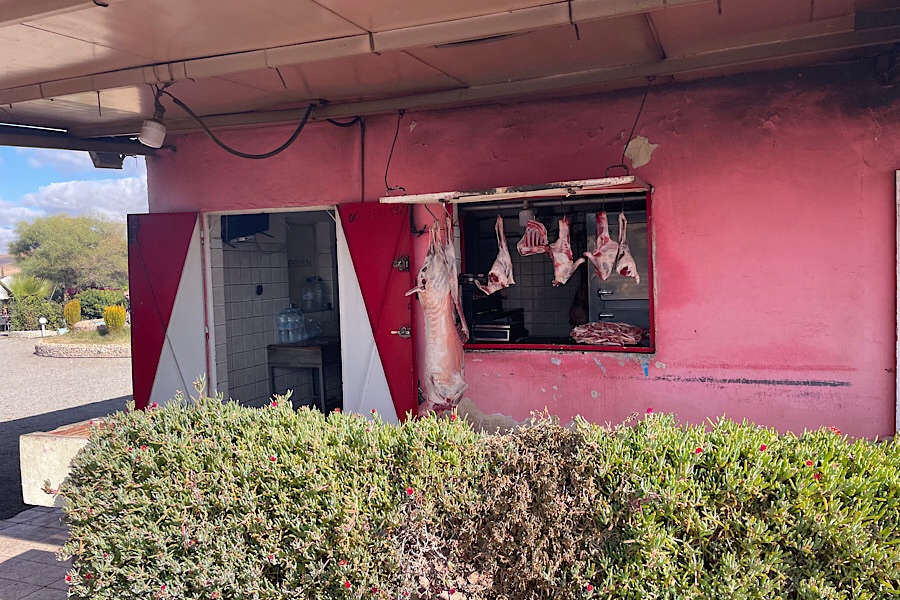


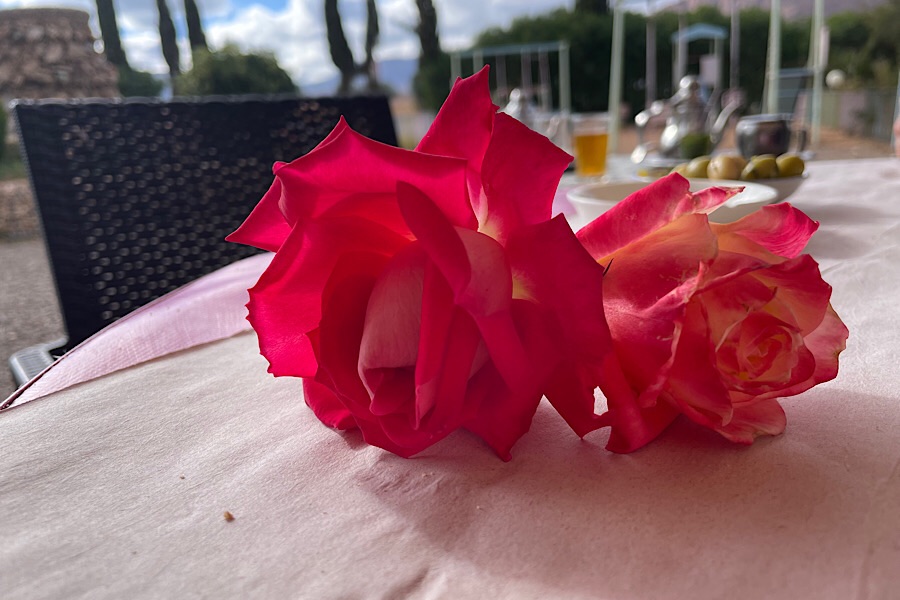
There is no menu the waiter tells me in heavily accented French which I struggle to understand, just one set menu with Moroccan salad (which turns out to be finely chopped tomatoes and onions in a tasty dressing), fresh bread, fries and freshly cooked lamb kebabs. We have a some confusion with our order as the meat seemed to be by the kilo only, which resulted in this arriving in effectively two courses. Kevin said it was the best lamb he had ever eaten and as I am veggie, he had easily enough for another meal dutifully wrapped in foil for us. Also with the obligatory portion wrapped in a napkin as a treat for the girls, sniffed out instantly by Lizzy as soon as the door to the truck was opened.
As we headed almost due south on the N17, a road which started as immaculate tarmac so you start to estimate your arrival prematurely. As soon as we dropped down to the plains, we returned to the old road which appeared to have been eaten by the desert on both sides creating a road about 1.5 carriageways wide. Therefore, another watchful drive as we had to give way to both oncoming and overtaking traffic, discretion being the better part of valour.
The further south we got, the bigger the horizon became, sand and scrub becoming the vegetation. After 30km, though we reached an oasis at the foot of the Atlas marked by trees and vegetation, here a natural spring flows continually into a trough, presumably a watering hole through the ages, now a concrete construction. Sadly though this was full of litter, like so many other places in Morocco and even in this remote location, a pack of dogs were keeping guard.
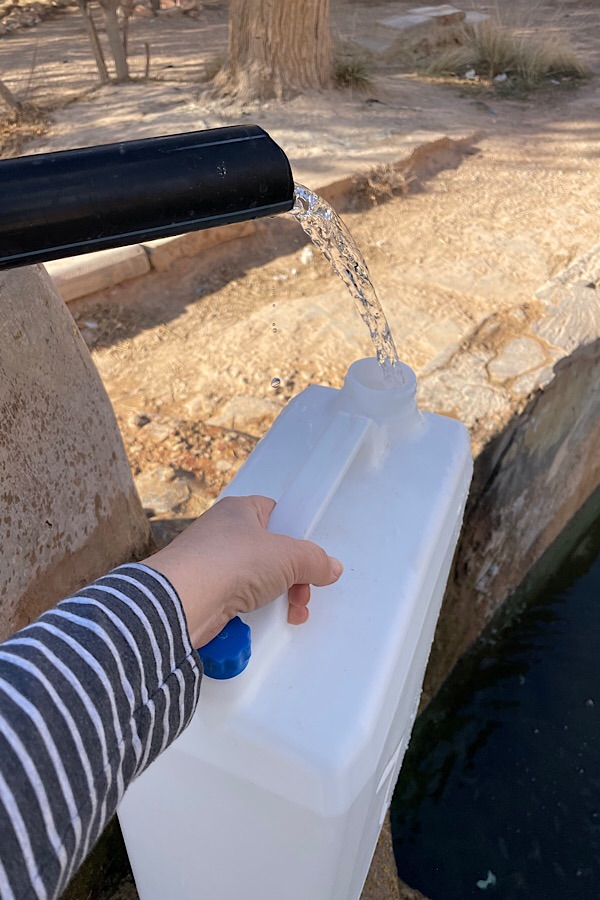


Based on recommendations for other travellers, we had chosen this spring to top up our water tanks before the desert, as many of the well-sourced water in the Sahara is strong tasting, even after filtering. We put into operation Kevin’s carefully prepared water filter system with electric pump using 2 x 25litre jerrycans to transfer the water from the spring flow. We use three levels of filtering just to put water in the tanks, plus another two filters and a UV lamp for a separate drinking water tap. We religiously use the filters to put any water in the tank and ironically our first level of filter became discoloured filtering tap water at a commercial Aire in France, proving the validity of our conservatism.

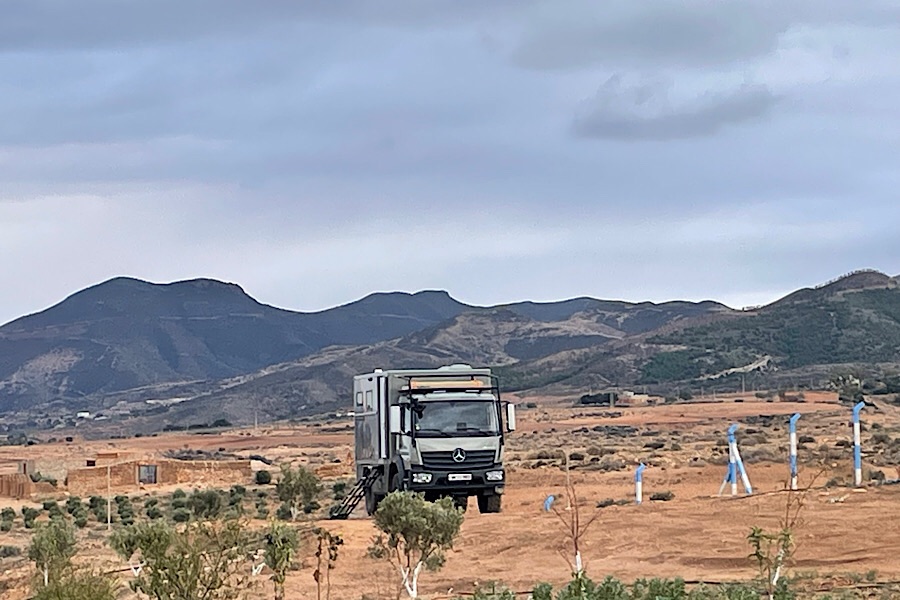
After our slightly extended lunch stop due to ordering issues and expect-the-unexpected road conditions, we were chasing sunlight to get to our park up in Tendrara for the night. However, we were so excited to be in the desert, the huge horizons were awesome, I was loving the camel road signs (though sadly no camels yet) and men in traditional headdresses and gowns, though in cars and cycles rather than on camels yet! It was surreal to finally be here ourselves in our truck.

We have passed probably upwards of 30 police stops on our journeys so far, they are at almost every roundabout in built up areas, usually with speed radars too, the police being very hot on speeding fines here. Ironically, having been waved through everyone, 3km from Tendrara we are stopped for the first time and asked for our passports (usually tourists are waved through, but we are close to Algeria now). They were still locked up in the cabin, so I scrambled into the back to get them. The smiling policeman gave them a close inspection and asked our plans, then happily waved us on.

As much as we are both itching to get our first night in the desert, wild camping is not strictly permitted and you really have to be out of sight, on a road like we have been on with long flat plains that would need to be several miles off the road to hide a 3.65m high overlander like ours and you need a proven track to do that. Therefore, we chose to take the recommended spot outside the police station. Only a few minutes after parking a policemen came out and dismissively waves off a local guy who had been hanging around nearby. He asks in French if we plan to stay the night and says we are welcome to do so, he asks us where we are heading to next and wishes us a good night. The friendly and regular presence of the police in Morocco is nothing but reassuring and welcoming so far.
 In for a Penney